First Time at a Sumo Show in Osaka: What to Expect
Wondering what to expect at a sumo show in Osaka? You don't need to know a single rule of sumo to enjoy your first show in Osaka. The wrestlers explain themselves through ritual and motion, an English-speaking MC narrates every bout, and the whole afternoon runs closer to live theater than a sporting event you have to study beforehand. The first time I sat ringside I worried I would miss the meaning behind the salt-throwing and the stomping and just see two large men collide; within the first ritual sequence, watching the MC translate it in real time, that worry disappeared. This guide is the walkthrough I wish someone had handed me: what actually happens minute by minute if you want to watch sumo wrestling in Osaka, the rituals explained, the etiquette that keeps everyone comfortable, and what changes if your visit lines up with the real March tournament instead.
Quick answer
A first-time sumo show in Osaka runs about 1 to 1.5 hours: rituals, a techniques demonstration, live bouts, an audience ring challenge, and a photo session, all narrated in English. Arrive 15 to 20 minutes early, and no prior knowledge of sumo is expected or needed.
Key takeaways
- Shows run 1 to 1.5 hours total, with everything explained by an English-speaking MC as it happens
- Arrive 15 to 20 minutes early; most venues seat guests on a first-come basis within their ticket tier
- The three rituals you'll see before nearly every bout, salt-throwing, shiko stomps and chiri-chozu clapping, are explained live, not left for you to decode
- Photos are usually welcome, but flash is off-limits during the bouts themselves
- Traveling with kids, the family pick is the show with the hot pot option at $68, which adds a hands-on training segment
- If your trip lines up with March instead, the etiquette shifts, covered fully in our March tournament guide
The Rituals You'll See Before Every Bout
Long before two wrestlers touch each other, a sumo bout is already underway, and the rituals are the part that confuses first-timers the most because nothing about them looks like a warm-up. Once the MC narrates what's happening, they stop feeling mysterious and start feeling like the point of the show. This is also the part of the show that separates a genuine sumo experience from a generic strongman demonstration: the same sequence, in the same order, has opened bouts for centuries, and watching it live rather than reading about it is the reason most visitors say the show felt more substantial than they expected.
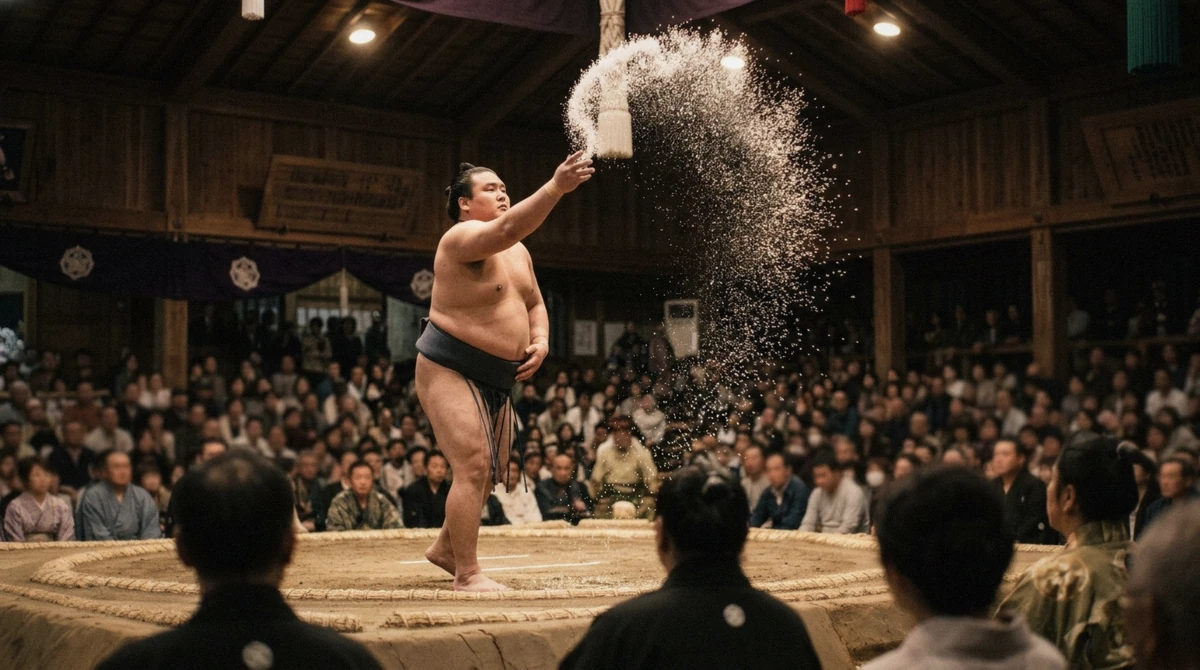
Salt-throwing
Each wrestler tosses a handful of salt across the ring before stepping in. It's a purification gesture, borrowed from Shinto practice, meant to cleanse the dohyo of anything unclean before the contest begins. Watch for it landing in a wide arc rather than a token sprinkle, wrestlers at the shows genuinely commit to the throw, and audiences often applaud it on its own.
Shiko stomps
The wide-legged, deep-knee stomp you'll see repeated a few times is the shiko. Traditionally it drives evil spirits out of the ring through the ground; practically, it's also a real strength and balance exercise that shows off a wrestler's power before contact even happens. First-timers usually clock this as the most photogenic single moment of the pre-bout sequence.
Chiri-chozu clapping
Wrestlers crouch, rub their hands together and clap once before spreading their arms wide, palms up. It's a gesture proving no weapon is hidden and that the contest ahead is fair. On the tourist-facing shows the MC usually times this explanation to land exactly as it happens, so you're never watching a gesture without knowing what it means.
All three rituals repeat before nearly every bout, which means by your third or fourth match you'll likely recognize them before the MC even says a word, one of the small satisfactions of watching more than one round. The wrestlers performing them are retired professionals, not actors, which is easiest to appreciate at the most popular show in Osaka, where the pre-bout ritual sequence runs longest.
| Ritual | What it means | When you'll see it |
|---|---|---|
| Salt-throwing | Purification of the ring before contest | Right before each wrestler steps to the ring's edge |
| Shiko stomps | Driving out evil spirits, also a strength display | Repeated a few times as wrestlers ready themselves |
| Chiri-chozu clapping | Proof of fair, unarmed contest | Just before the crouch that opens the bout |
What Happens at a Sumo Show, Minute by Minute
Formats vary slightly by venue, but this is the shape nearly every Osaka sumo show follows.
-
15-20 min before start
Arrival and seating
Doors open early enough to find your seat, use the restroom and settle in before the MC opens the show; arriving on the ticket time itself risks a rushed seat search
-
First 10-15 min
Introduction and rituals
The MC introduces the wrestlers and the venue, then the salt-throwing, shiko stomps and chiri-chozu clapping open the show, explained live in English as they happen
-
Next 20-25 min
Techniques demonstration
Wrestlers walk through real kimarite (winning techniques), showing how a bout is actually won, not just staged contact, with the MC narrating the mechanics of each move
-
Following 20-30 min
Live bouts
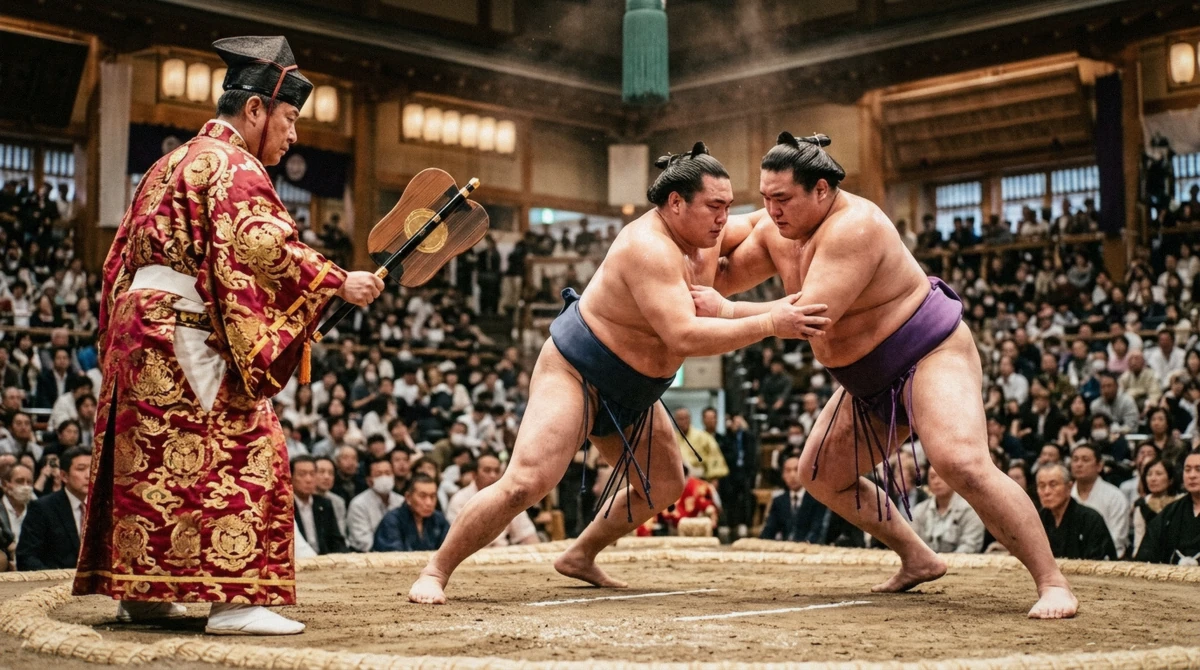
One or more genuine one-round matches (tachiai), full-speed and full-contact between former professional wrestlers, the closest thing to a real sumo match most visitors will ever see up close
-
Final 15-20 min
Audience challenge and photos
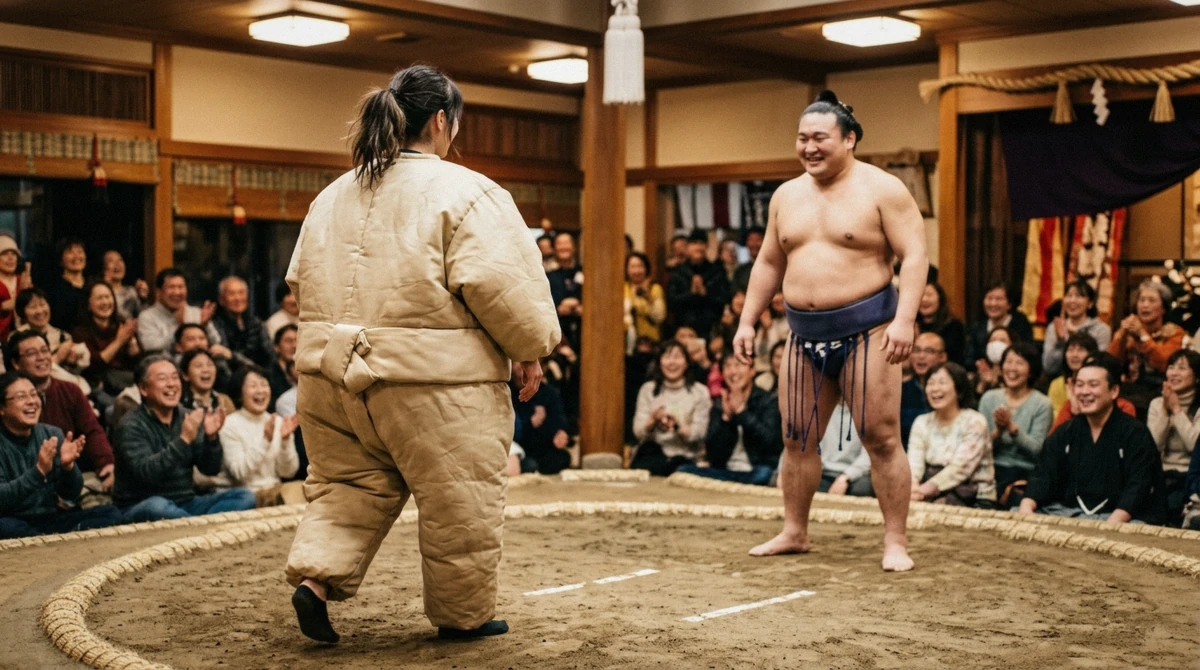
A guest is invited to put on a mawashi and step into the ring against a wrestler, followed by a group or individual photo session with the rikishi to close the show
Etiquette and Photo Rules
Tourist-facing sumo shows are relaxed compared with the formal tournament, but a handful of rules keep the room comfortable for everyone.
The essentials to know before you sit down:
- Photos are generally welcome throughout the show, including the rituals and bouts
- Flash photography is not allowed during the bouts themselves, it startles the wrestlers mid-contact and most venues will ask you to stop if you forget
- Stay in your seat during a bout rather than standing to get a better angle, other guests behind you are watching too
- Applause is encouraged after a strong throw or a decisive win, this isn't a hushed formal hall
- The post-show photo session with the wrestlers is included at most shows, so save your best shot request for that structured moment rather than trying to get one mid-bout
- Follow the MC's instructions if you're chosen for the ring challenge, they'll walk you through exactly what to do
None of this requires advance homework. The MC restates the flash rule before the bouts begin at nearly every show, so even if you walk in cold, you won't miss it. Staff at every venue are used to first-timers asking where to stand, when photos are welcome and what happens next, so a quiet question to an usher during a lull is always a safer bet than guessing.
What to Wear and Bring (the Short Version)
Nothing about a sumo show calls for special gear. Comfortable clothes you'd wear to any indoor theater work fine, and most venues keep the room at a normal temperature year-round.
The short packing list:
- Comfortable shoes, you'll likely be on your feet briefly during entry and the photo session
- A phone or camera, photos are welcome through most of the show
- Small cash, some venues sell snacks or souvenirs that don't take cards
- A light layer, indoor air conditioning runs strong in summer
- Your booking confirmation, shown at entry for fast-track seating
That's genuinely the whole list. Shows like the live show with the audience challenge run the same relaxed dress code as any theater seat in Osaka, no costume, no special footwear, nothing to buy in advance.
Taking Kids to a Sumo Show
Sumo shows in Osaka are genuinely family-friendly, and the format helps: the rituals are visual and easy to follow without reading, the MC's commentary is upbeat rather than technical, and the pace never sits still long enough for young attention spans to wander.
The family pick on this site is the show with the hot pot option at $68, which adds a hands-on segment where kids can try basic training drills after the main show, plus an optional chanko nabe meal, the wrestlers' own hot pot, if your family wants to make an evening of it. It also offers discounted children's pricing, which the more theatrical shows don't always match.
A few practical notes for parents: the loudest single moment is the audience challenge, when the crowd cheers as a guest steps into the ring, so a child sensitive to sudden noise should sit further back rather than in the front rows. Bathroom breaks are easiest between the techniques demonstration and the live bouts, when the room briefly resets.
If You Go to the March Tournament Instead
Everything above describes the year-round tourist shows. If your Osaka trip happens to fall in March, during the real Grand Sumo Tournament, a few etiquette points change and matter more than they do at a show. In the traditional masu box seats, shoes come off and you sit on cushions rather than in a chair.
You may leave and re-enter once during the day, but only with a re-entry stamp from staff, so don't wander off without asking first. The atmosphere is quieter and more formal throughout, closer to a spectator sport than a performance.
That's the short version. Ticket tiers, prices, dates and how to actually book a seat are covered in full in our March tournament guide, and if you're weighing whether the tournament or a show is the better use of your trip, our honest comparison walks through exactly what changes.
| Rule | At a show | At the March tournament |
|---|---|---|
| Footwear | Keep your shoes on in theater-style seating | Shoes off in masu box seats, sit on cushions |
| Leaving your seat | Come and go freely between bouts | One re-entry only, with a staff re-entry stamp |
| Photos | Welcome, no flash during bouts | Welcome, no flash, stay seated during bouts |
| Atmosphere | Lively, audience cheering encouraged | Quieter and more formal throughout |
None of this requires prior sumo knowledge, a strong grasp of Japanese, or advance study of the rituals. Show up 15 to 20 minutes early, let the MC do the explaining, and the rest follows naturally, salt, stomps, claps, a real bout, and a photo to take home.
What happens if I arrive right at the ticket time instead of early?
You'll likely still get in, but seating within your ticket tier is often first-come, so arriving right at start time can mean a seat further from the ring than if you'd arrived 15 to 20 minutes ahead.
Why do wrestlers throw salt before a bout?
It's a Shinto-rooted purification gesture meant to cleanse the ring before the contest, one of three rituals (with the shiko stomps and chiri-chozu clapping) that open nearly every bout at a show.
What are the photo rules during the bouts?
Photos are welcome through most of the show. The one restriction is flash during the bouts themselves, which the MC typically reminds guests of before the matches start.
How does the audience ring challenge actually work?
Near the end of the show, a guest is invited to put on a mawashi and face a wrestler in the ring, guided step by step by the MC. It closes the show alongside the photo session.
Which show is best for a family with young kids?
The show with the hot pot option at $68 is the family pick, with a hands-on training segment for kids and discounted children's pricing on top of the show itself.
How is the etiquette different if I go during the March tournament?
At the tournament, masu box seating means shoes off and sitting on cushions, and you may leave and re-enter once with a staff re-entry stamp. Full details are in our dedicated tournament guide.